
Updates
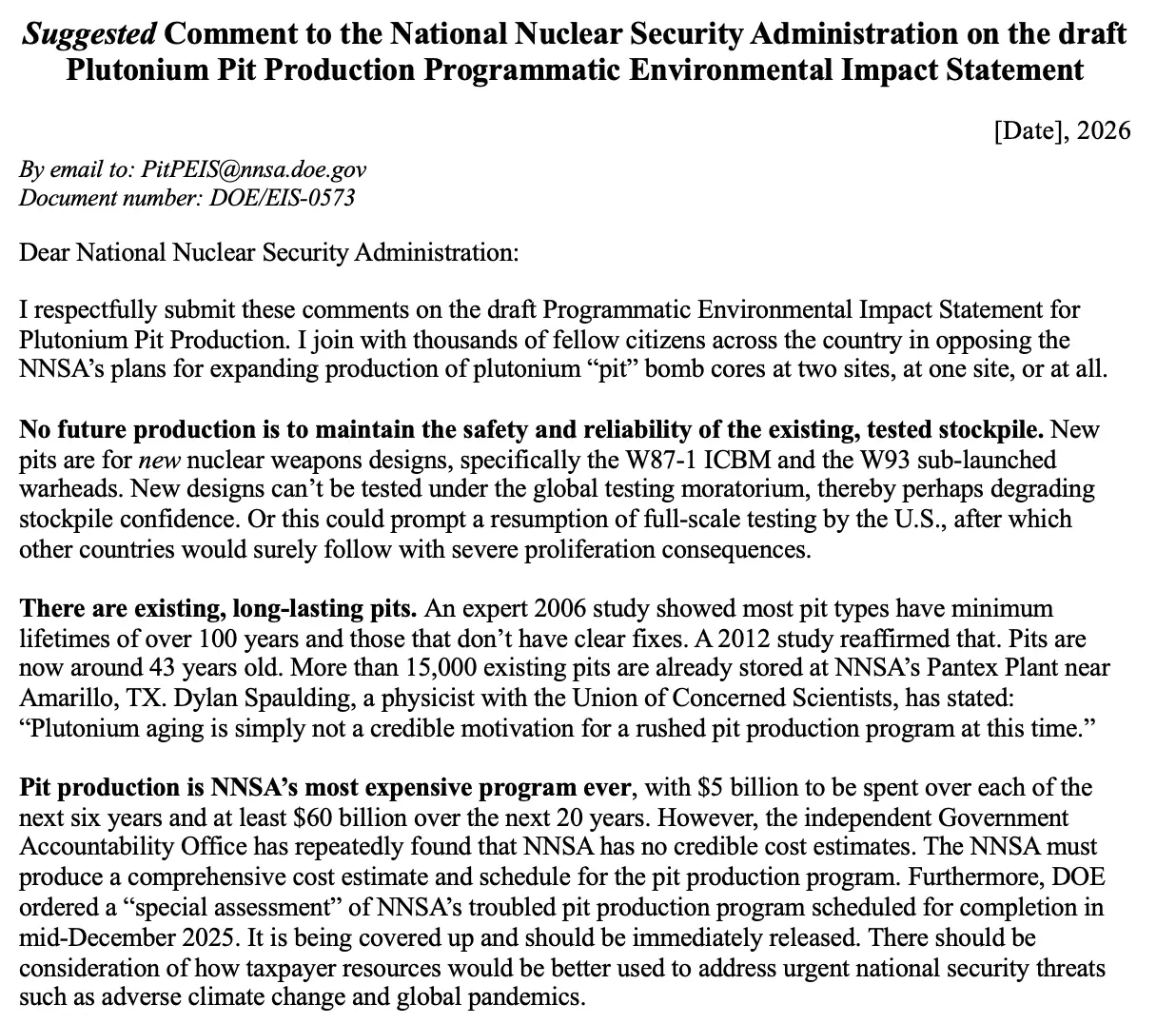
Sample Comments for the Draft Plutonium Pit Production Programmatic Environmental Impact Statement (PEIS)
Why should you comment? This process produces valuable information, increases government accountability and transparency, and creates a legal administrative record that has led to important litigation in the past. The Trump administration is severely limiting and removing key opportunities for public comment and objection. Significantly, there is no other legally required opportunity that enables the public to comment on the “modernization” program to keep nuclear weapons forever.
BACKGROUND: The Department of Energy’s (DOE’s) semi-autonomous National Nuclear Security Administration (NNSA) is aggressively expanding the production of plutonium pits, the radioactive cores or “triggers” of nuclear weapons. The Los Alamos National Laboratory (LANL) in New Mexico has been capable of producing plutonium pits since 1996, and until 2018 production was capped at no more than 20 pits per year. NNSA now plans to produce up to 205 pits every year for the new arms race, with at least 80 pits per year made at LANL and at least 125 per year at the Savannah River Site (SRS) in South Carolina.
Grassroots activist organizations Nuclear Watch New Mexico of Santa Fe, NM; Savannah River Site Watch of Columbia, SC; the Gullah/Geechee Sea Island Coalition of coastal Georgia, and Tri-Valley CARES of Livermore, CA successfully sued the NNSA over its failure to complete a required nationwide “programmatic environmental impact statement” (PEIS) for its plan to massively expand plutonium pits production. A draft of this PEIS was released in April 2026, kicking off in-person hearings in Livermore, CA, Santa Fe, NM, Aiken, SC, Kansas City, MO, and Washington, DC, as well as a 90-day public comment period ending July 16, 2026. This provides a unique and critical opportunity for public scrutiny of and formal comment on the government’s plans to make new nuclear bombs for a new arms race!
Plutonium Pit Production Draft PEIS – Recording of Public Hearing in Santa Fe, NM, Thurs May 14, 2026

Plan to increase nuclear pit production at Los Alamos lab gets heavy pushback at Santa Fe forum
“The environmental impact statement was produced as a result of a January 2025 settlement between the National Nuclear Security Administration and various groups, including Nuclear Watch New Mexico. The lawsuit claimed the federal government failed to appropriately consider the impacts of production of plutonium pits at LANL and the Savannah River Site, under national environmental law.”
| May 14, 2026 santafenewmexican.com
A draft environmental impact statement on the production of the trigger devices for nuclear weapons faced overwhelming public pushback Thursday evening at a Santa Fe hearing.
The roughly 130 people who attended the meeting at the Santa Fe Farmers Market Institute in person and 100 more who joined online were almost all against plutonium pit production in their backyard — and many criticized the nuclear industry.
Sean Arent, a member of Washington Physicians for Social Responsibility, brought up that state’s long cleanup process at the Hanford Site, a defunct and decommissioned plutonium production site.
The hearing was one of five scheduled around the country this month and follows meetings in South Carolina, Missouri and California. The final hearing is planned for May 20 in Washington, D.C., and does not have a virtual option.
Nuclear Weapons Issues & The Accelerating Arms Race: May 2026
Nuclear Weapons:
https://www.twz.com/nuclear/new-nuclear-bunker-buster-bomb-plans-revealed
New Nuclear Bunker Buster Bomb Plans Revealed The Department of Energy is seeking millions of dollars for work in part on a new bunker-busting nuclear weapon called the Nuclear Deterrent System-Air-delivered (NDS-A) in its latest budget request… Beyond that it will be air-delivered, there are also no details currently available publicly about the weapon’s design, including whether it will be based on something already in the stockpile.
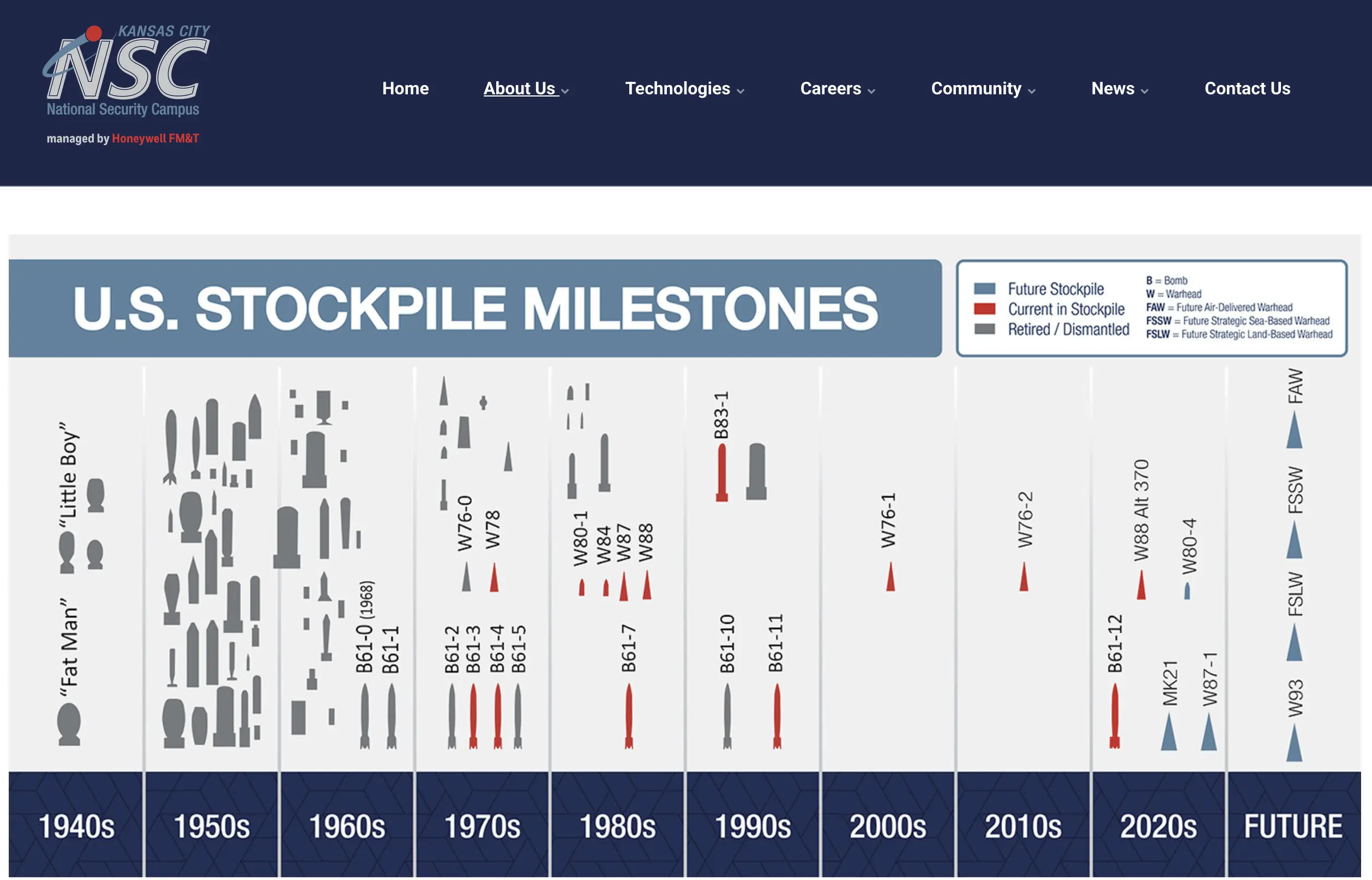
See the graph below found on the Kansas City National Security Complex website. There are three future new-design nuclear weapons on the right above the W93 (“F” is all 3 cases means “Future”). These new-design nuclear weapons presumably will have new-design pits like the W93.
COMMENT TRAINING for the Plutonium Pit Production Draft PEIS – Recording of Kansas City-Focused Training May 6, 2026
Learn more about the government’s plan to mass produce new plutonium pits for nuclear weapons, Kansas City’s role in this program, and how to give a well-informed and impactful testimony at the public comment hearing in Kansas City on May 7 or submit written comments until July 16.
Presented by PeaceWorks KC, Physicians for Social Responsibility KC, Veterans for Peace KC and special guests from Nuclear Watch New Mexico and the Union of Concerned Scientists.
See more info at https://PitPEIS.com
https://peaceworkskc.org/plutonium/

Plutonium Pit Production Draft PEIS – Recording of Public Hearing North Augusta, South Carolina, Tues May 5, 2026

Kansas City: Inside America’s Nuclear Weapons Capital, As It Builds the Newest American Bomb
“For seventy-seven years, Kansas City has built most of nearly every American nuclear weapon. On May 7, the federal government will hold a hearing to ask if Kansas City consents to the next chapter.”
By | May 6, 2026 kansascitydefender.com
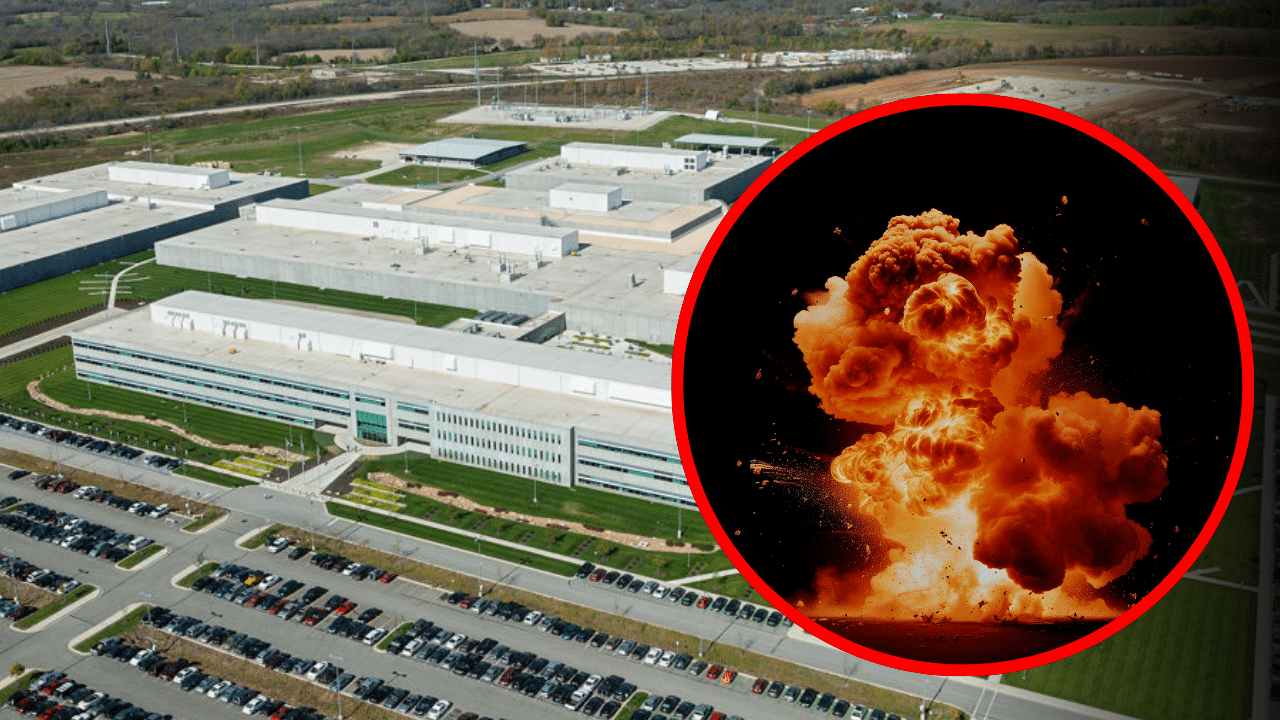
His hands did the work. Maurice Copeland was a tool and die supervisor at the Kansas City Plant for the last twelve of his thirty-two years there, and for most of that time he passed chemicals he did not know were poison across a workbench to men he supervised.

He was a Black Vietnam veteran when Bendix Corporation hired him in 1968, one among thousands of Black returning soldiers Bendix brought in as the Cold War pushed weapons assembly to wartime pace.
The plant at 1500 East Bannister Road sat at the edge of Troost Avenue, the apartheid line that has divided this city since before he was born. What Copeland and the men he supervised handled with their bare hands, included benzene, beryllium, trichloroethylene, polychlorinated biphenyls, asbestos, mercury, lead, and depleted uranium. Group 1 carcinogens.
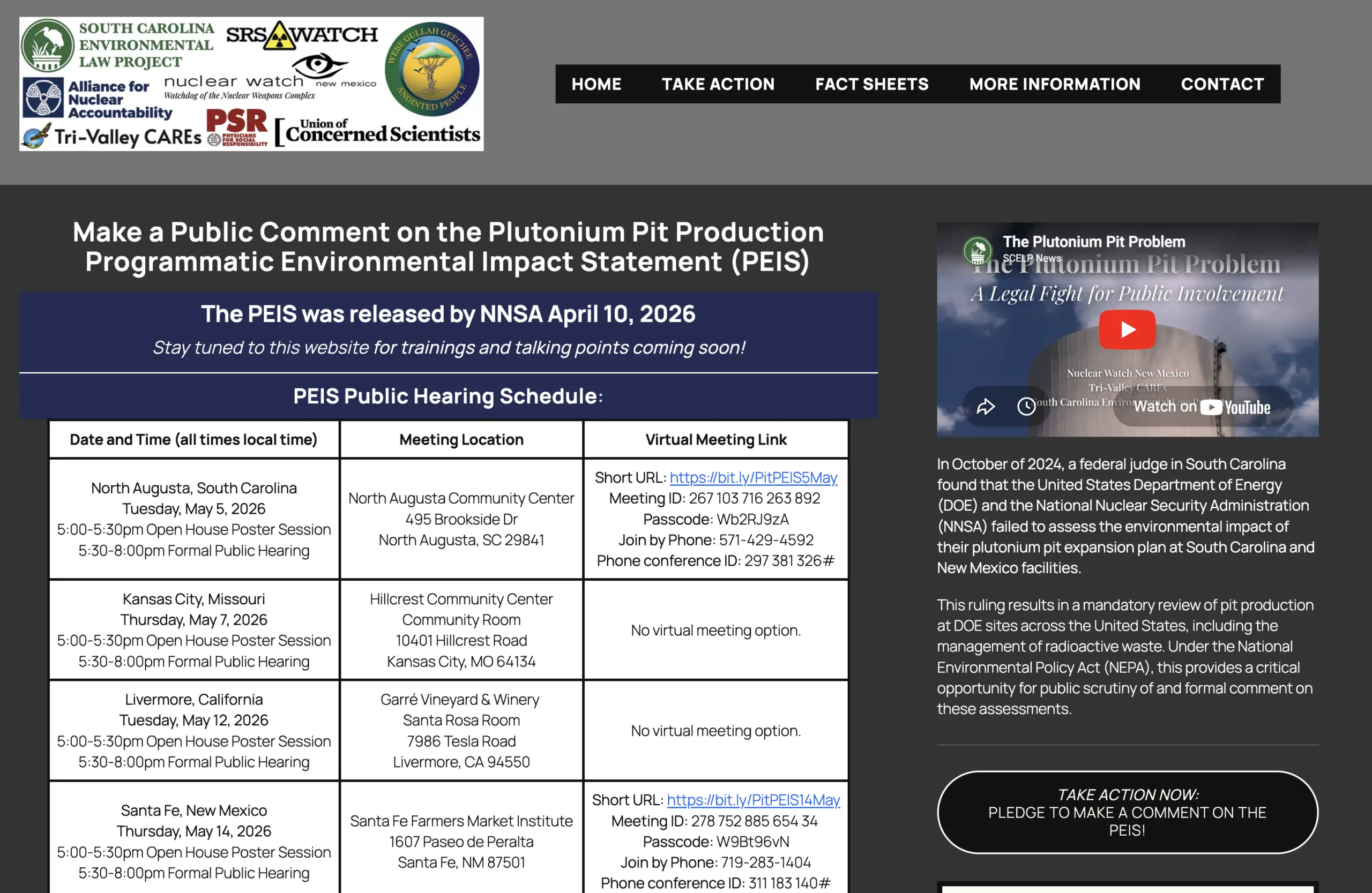
Plutonium Pit Production Programmatic Environmental Impact Statement (PEIS) is Out Now! Visit PitPEIS.com for More!
The Draft Programmatic Environmental Impact Statement (PEIS) for Plutonium Pit Production was released by NNSA on Friday, April 10th. This opens a critical window for public comment on NNSA’s unnecessary plan to expand production of plutonium “pit” bomb cores. This PEIS was brought on by a lawsuit against NNSA over its failure to complete the NEPA process for this plan. As you likely know, NEPA is fully under attack by the current administration — this may be the last foreseeable full NEPA process taking place, making it all the more critical to be involved.
As a resource to help you comment and encourage widespread comment-making in your community, we (lawsuit plaintiffs Nuclear Watch New Mexico and Tri-Valley CAREs, as well as the Union of Concerned Scientists, Physicians for Social Responsibility, and groups from the Alliance for Nuclear Accountability), created a website that is now live!
Your Pit PEIS central hub for information and action: https://pitpeis.com/
Please take a look and feel free to share, and note that we’ll be continuing to update it as soon as new resources become available.
For example, we will soon have:
– A schedule of comment trainings
– Sample comments and talking points
– Regional-focused resources to help engage your local community around this issue
Nuclear Weapons Issues & The Accelerating Arms Race: April 2026
Nuclear Weapons:
Trump has gone beyond the pale, threatening to wipe out an entire civilization (Iran). The Senate majority leader John Thune tweeted thuggishly, “Iran would be wise to take President Trump at his word. They can choose the easy way or the hard way.” Speaker Mike Johnson had adjourned the House.
There is only one thing made by man that can wipe out a civilization overnight and that is nuclear weapons. NNSA and LANL are all complicit in this. 46 Democratic House members have invoked the 25th amendment to get rid of Trump but no Republicans. We have a two week truce which Netanyahu seems determined to destroy by carpet bombing Lebanon.
FY 2027 budget: See press release and press release.
- Military spending in FY 2026 was already a record breaker at $1 trillion. Trump proposes nearly $1.5 trillion for FY 2027. $1.1 trillion as base budget, $355 billion through reconciliation.
- $18 billion for Golden Dome through reconciliation. In the Alice in Wonderland world of nuclear weapons policies, defense is offense.
- $53.9 billion for the Department of Energy (DOE) in FY 2027. Sixty-one per cent ($32.8 billion) is for its semi-autonomous nuclear weapons agency, the National Nuclear Security Administration (NNSA). DOE’s Office of Science is gutted by $1.1 billion which “eliminates funding for climate change and Green New Scam research.” DOE’s Office of Energy Efficiency and Renewable Energy is eliminated. Nationwide cleanup of legacy Cold War radioactive and toxic wastes at DOE sites is cut by $386 million to $8.2 billion. LANL’s cleanup program is given a modest 5% bump but there is escalating conflict with the New Mexico Environment Department.
- Funding for plutonium pit production is increased by 87%, an average of $5.1 billion in projected costs for each year FY 2028-2031, pretty much equally divided between LANL and the Savannah River Site (SRS) in South Carolina. LANL will spend $14 billion for pit production over the next six years. None of this is to maintain the safety and reliability of the existing nuclear weapons stockpile. It is all for new designs.
- Aggressive nuclear warhead production, including the new-design W93. More new designs in the wings.
Performance Evaluation Reports: Received via the Freedom of Information Act and posted into NNSA’s E-FOIA reading room, thanks to our two earlier lawsuits. Concerning the LANL PER please see our press release at https://nukewatch.org/press-release-item/lanl-2025-per-pr-3-6-26/ Tom Clements of SRS Watch points out that the SRS PER makes clear poor contractor performance at the Savannah River Plutonium Processing Facility. This shows the value of the PERs and can be used as a cudgel against them. I smell blood in the water over the Savannah River Plutonium Processing Facility.
LANL AI center in Ypsilanti, MI: The Township lawyer contacted me after the article Tiny City Fears Iran Drone Strikes Because of New Nuclear Weapons Datacenter was published. I ended up having a 1.5 hour zoom with him and Township staff. They are fighting LANL’s AI center hard. I sent them our press release on the LANL SWEIS which they say was helpful. In response to a commenter’s question (probably me), the final SWEIS explicitly says that a data center will not be built at LANL. However, it completely fails to mention the one in Ypsilanti, is really duplicitous.
Accelerating Arms Race: Trump’s threat to obliterate a 7.000 year old civilization. Now Iran will really want nuclear weapons.
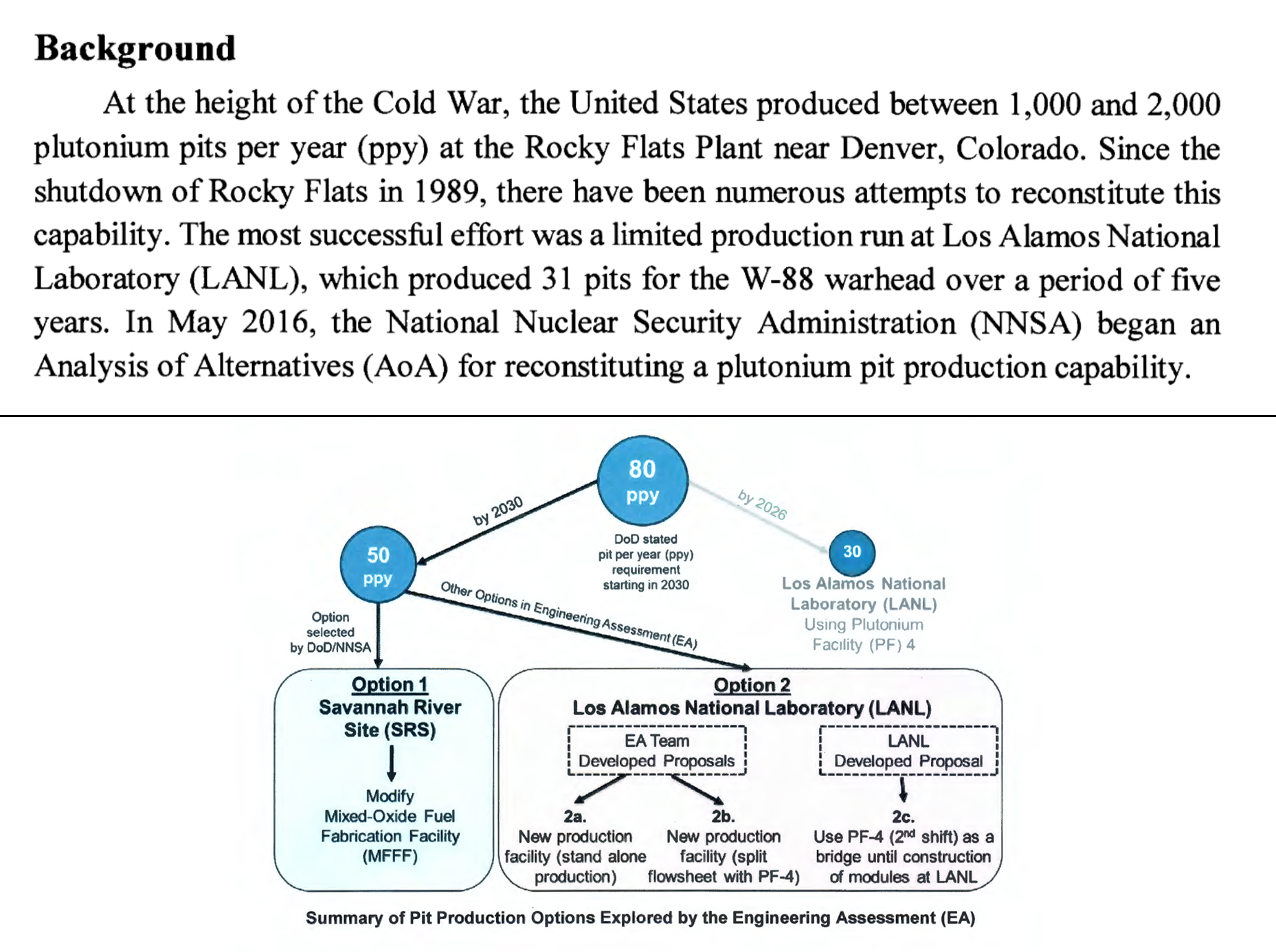
IDA Executive Summary on Pit Production
NukeWatch Recent Related Work
Sample Comments for the Draft Plutonium Pit Production Programmatic Environmental Impact Statement (PEIS)
Why should you comment? This process produces valuable information, increases government accountability and transparency, and creates a legal administrative record that has led to important litigation in the past. The Trump administration is severely limiting and removing key opportunities for public comment and objection. Significantly, there is no other legally required opportunity that enables the public to comment on the “modernization” program to keep nuclear weapons forever.
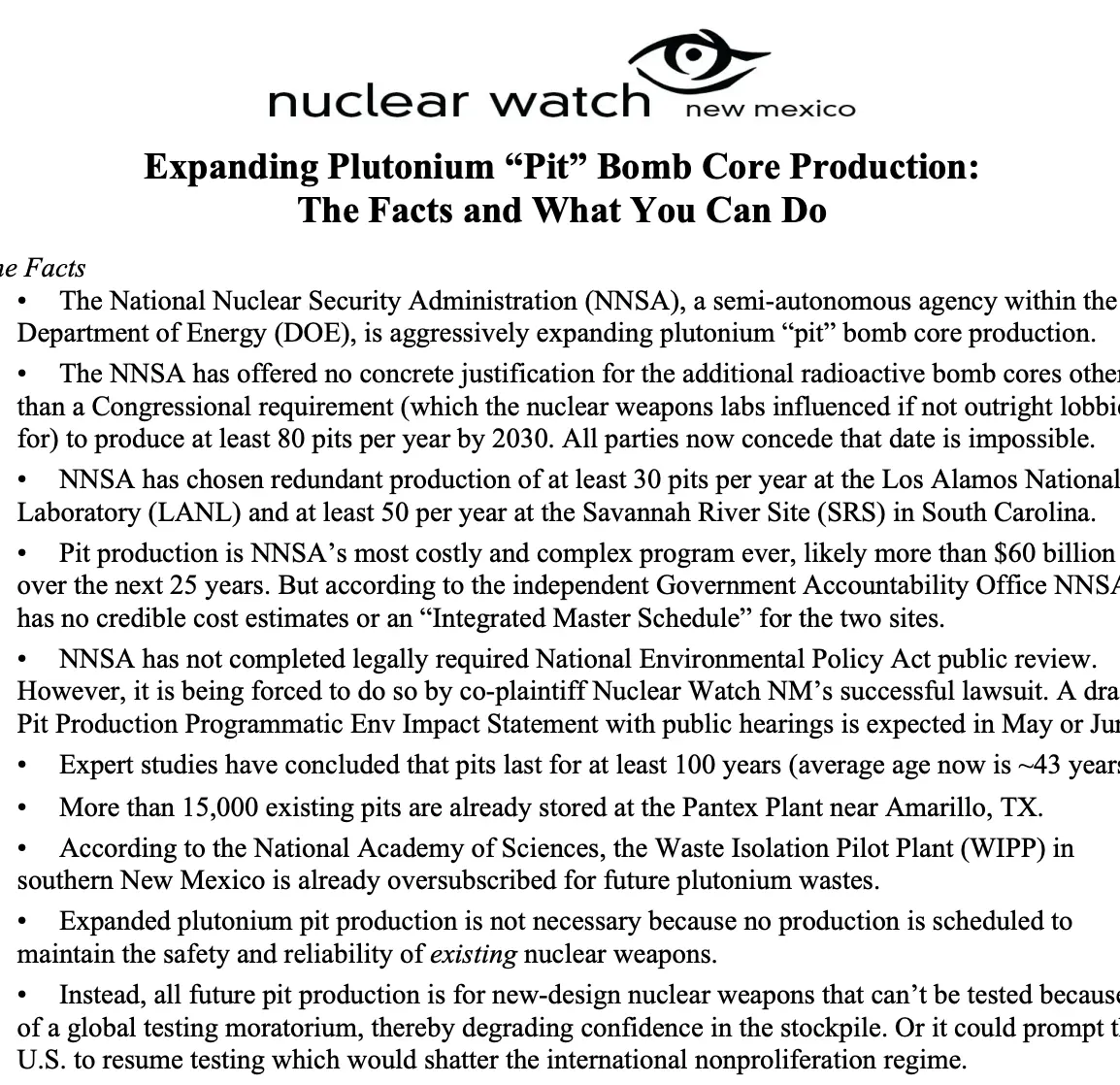
BACKGROUND: The Department of Energy’s (DOE’s) semi-autonomous National Nuclear Security Administration (NNSA) is aggressively expanding the production of plutonium pits, the radioactive cores or “triggers” of nuclear weapons. The Los Alamos National Laboratory (LANL) in New Mexico has been capable of producing plutonium pits since 1996, and until 2018 production was capped at no more than 20 pits per year. NNSA now plans to produce up to 205 pits every year for the new arms race, with at least 80 pits per year made at LANL and at least 125 per year at the Savannah River Site (SRS) in South Carolina.
Grassroots activist organizations Nuclear Watch New Mexico of Santa Fe, NM; Savannah River Site Watch of Columbia, SC; the Gullah/Geechee Sea Island Coalition of coastal Georgia, and Tri-Valley CARES of Livermore, CA successfully sued the NNSA over its failure to complete a required nationwide “programmatic environmental impact statement” (PEIS) for its plan to massively expand plutonium pits production. A draft of this PEIS was released in April 2026, kicking off in-person hearings in Livermore, CA, Santa Fe, NM, Aiken, SC, Kansas City, MO, and Washington, DC, as well as a 90-day public comment period ending July 16, 2026. This provides a unique and critical opportunity for public scrutiny of and formal comment on the government’s plans to make new nuclear bombs for a new arms race!

Historic Settlement Reached in NEPA Lawsuit Over Plutonium “Pit” Bomb Core Production
FOR IMMEDIATE RELEASE, January 17, 2025
Media Contacts:
Ben Cunningham, Esquire, SCELP, 843-527-0078, ben@scelp.org
Tom Clements, Savannah River Site Watch, 803-834-3084, tomclements329@cs.com
Jay Coghlan, Nuclear Watch New Mexico, 505-989-7342, jay@nukewatch.org
Scott Yundt, Tri-Valley CAREs, 925-443-7148, scott@trivalleycares.org
Queen Quet, Gullah/Geechee Sea Island Coalition, 843-838-1171, GullGeeCo@aol.com
AIKEN, S.C. — Nonprofit public interest groups have reached an historic settlement agreement with the Department of Energy’s semi-autonomous nuclear weapons agency, the National Nuclear Security Administration (NNSA). This is the successful result of a lawsuit against NNSA over its failure to complete a programmatic environmental impact statement on the expanded production of plutonium “pit” bomb cores, as required by the National Environmental Policy Act (NEPA). This agreement and a joint motion to dismiss have been submitted to Judge Mary Lewis Geiger of the Federal District of South Carolina. Should the Court enter the dismissal and retain jurisdiction to enforce the settlement, the agreement will go into effect.
This lawsuit was first filed in June 2021 by co-plaintiffs Savannah River Site Watch of Columbia, SC; Nuclear Watch New Mexico of Santa Fe, NM; Tri-Valley Communities Against a Radioactive Environment (CAREs), based in Livermore, CA; and the Gullah/Geechee Sea Island Coalition of coastal Georgia. NNSA promptly moved to have the case dismissed which in February 2023 Judge Lewis rejected, calling her decision “not a close call.”
Court Rules U.S. Nuclear Weapons Production Plan Violates Federal Law
FOR IMMEDIATE RELEASE, October 3, 2024
Media Contacts:
Ben Cunningham, Esquire, SCELP, 843-527-0078, ben@scelp.org
Tom Clements, Savannah River Site Watch, 803-834-3084, tomclements329@cs.com
Jay Coghlan, Nuclear Watch New Mexico, 505-989-7342, jay@nukewatch.org
Scott Yundt, Tri-Valley CAREs, 925-443-7148, scott@trivalleycares.org
Queen Quet, Gullah/Geechee Sea Island Coalition, 843-838-1171, GullGeeCo@aol.com
AIKEN, S.C. — On September 30, United States District Court Judge Mary Geiger Lewis ruled that the United States Department of Energy (“DOE”) and its semi-autonomous nuclear weapons agency, the National Nuclear Security Administration (“NNSA”), violated the National Environmental Policy Act (“NEPA”) by failing to properly consider alternatives before proceeding with their plan to produce plutonium pits, a critical component of nuclear weapons, at the Los Alamos National Laboratory (“LANL”) in New Mexico and, for the first time ever, at the Savannah River Site (“SRS”) in South Carolina.
The Court found that the plan’s purpose had fundamentally changed from NNSA’s earlier analyses which had not considered simultaneous pit production at two sites. These changes necessitated a reevaluation of alternatives, including site alternatives, which Defendants failed to undertake prior to moving forward while spending tens of billions of taxpayers’ dollars. Therefore, the Court entered judgment in favor of Plaintiffs, the nonprofit public interest groups Savannah River Site Watch, Nuclear Water New Mexico and Tri-Valley Communities Against a Radioactive Environment (CAREs); the Gullah/Geechee Sea Island Coalition; and Tom Clements as an individual plaintiff.
As a result of this ruling, the Defendants are required to newly assess pit production at a nation-wide programmatic level which will mean undertaking a thorough analysis of the impacts of pit production at DOE sites throughout the United States, including radioactive waste generation and disposal. Under the National Environmental Policy Act (NEPA), this will provide the opportunity for public scrutiny of and formal comment on their assessments.

High Detections of Plutonium in Los Alamos Neighborhood – As We Enter a New Nuclear Arms Race the Last One is Still Not Cleaned Up
FOR IMMEDIATE RELEASE, August 15, 2024
Dr. Michael Ketterer – 928.853.7188 | Email
Jay Coghlan – 505.989.7342 | Email
Santa Fe, NM – In April Nuclear Watch New Mexico released a map of plutonium contamination based on Lab data. Today, Dr. Michael Ketterer, Professor Emeritus of Chemistry and Biochemistry, Northern Arizona University, is releasing alarmingly high results from samples taken from a popular walking trail in the Los Alamos Town Site, including detections of some of the earliest plutonium produced by humankind.
On July 2 and 17 Dr. Ketterer, with the assistance of Nuclear Watch New Mexico, collected water, soil and plant samples from Acid Canyon in the Los Alamos Town Site and soil and plant samples in Los Alamos Canyon at the Totavi gas station downstream from the Lab. The samples were prepared and analyzed by mass spectrometry at Northern Arizona University to measure concentrations of plutonium, and to ascertain its sources in the environment.

NNSA Delays Urgent Research on Plutonium “Pit” Aging While Spending Tens of Billions on Nuclear Weapons Bomb Core Production
FOR IMMEDIATE RELEASE, April 17, 2024
Tom Clements, SRS Watch – 803.240.7268 | Email
Scott Yundt, TVC – 415.990.2070 | Email
Jay Coghlan – 505.989.7342 | Email
Nearly three years after filing a Freedom of Information Act request, the public interest group Savannah River Site Watch has finally received the National Nuclear Security Administration’s (NNSA’s) congressionally-required “Research Program Plan for Plutonium and Pit Aging.” However, the document is 40% blacked out, including references and acronyms. Plutonium “pits” are the radioactive cores of all U.S. nuclear weapons. The NNSA claims that potential aging effects are justification for a ~$60 billion program to expand production. However, the Plan fails to show that aging is a current problem. To the contrary, it demonstrates that NNSA is delaying urgently needed updated plutonium pit aging research.
In 2006 independent scientific experts known as the JASONs concluded that plutonium pits last at least 85 years without specifying an end date [i] (the average pit age is now around 40 years). A 2012 follow-on study by the Lawrence Livermore nuclear weapons lab concluded:
“This continuing work shows that no unexpected aging issues are appearing in plutonium that has been accelerated to an equivalent of ~ 150 years of age. The results of this work are consistent with, and further reinforce, the Department of Energy Record of Decision to pursue a limited pit manufacturing capability in existing and planned facilities at Los Alamos instead of constructing a new, very large pit manufacturing facility…” [ii]
Since then NNSA has reversed itself. In 2018 the agency decided to pursue the simultaneous production of at least 30 pits per year at the Los Alamos National Laboratory (LANL) in northern New Mexico and at least 50 pits per year at the Savannah River Site (SRS) in South Carolina. Upgrades to plutonium facilities at LANL are slated to cost $8 billion over the next 5 years. The redundant Savannah River Plutonium Processing Facility in South Carolina will cost up to $25 billion, making it the second most expensive building in human history.
NNSA’s Nuclear Weapons Budget Takes Huge Jump
Arms Race Accelerates with MIRVed Warheads
Los Alamos Lab Cleanup Cut
FOR IMMEDIATE RELEASE, March 11, 2024
Jay Coghlan – 505.989.7342 | Email
Santa Fe, NM – Ironically the day after the film Oppenheimer was awarded multiple Oscars, the Department of Energy’s semi-autonomous National Nuclear Security Administration (NNSA) asked Congress for its biggest nuclear weapons budget ever. NNSA’s FY 2025 request for “Total Weapons Activities” is $19.8 billion, $700 million above what Congress recently enacted for FY 2024. It is also a full billion dollars above what President Biden asked for last year, which Congress then added to and will likely do so again.
The Biden Administration states that the $19.8 billion will be used to:
“[P]rioritize implementation of the 2022 National Defense Strategy and Nuclear Posture Review by modernizing the Nation’s nuclear deterrent to keep the American people safe. The Budget supports a safe, secure, reliable, and effective nuclear stockpile and a resilient, responsive nuclear security enterprise necessary to protect the U.S. homeland and allies from growing international threats.” whitehouse.gov/wp-content/uploads/2024/03/budget_fy2025.pdf, page 75.
The 2022 National Defense Strategy and Nuclear Posture Review for the first time posited two nuclear “near peers”, i.e. Russia and China, that need to be simultaneously “deterred.” This hinted at a potentially large nuclear buildup which this budget may now be implementing. That claimed need to deter two nuclear near peers was explicitly taken a step beyond just deterrence in an October 2023 report from the Strategic Posture Commission. It declared:
“Decisions need to be made now in order for the nation to be prepared to address the threats from these two nuclear-armed adversaries arising during the 2027-2035 timeframe. Moreover, these threats are such that the United States and its Allies and partners must be ready to deter and defeat both adversaries simultaneously.” ida.org/research-and-publications/publications/all/a/am/americas-strategic-posture, page vii (bolded emphasis added)
NNSA Suppresses How Taxpayers Money Is Spent
FOR IMMEDIATE RELEASE, January 19, 2024
Jay Coghlan – 505.989.7342 | Email
Santa Fe, NM – The National Nuclear Security Administration (NNSA) has just released cursory two or three page summaries of contractors’ performance paid for by the American taxpayer. For the just ended fiscal year 2023, NNSA gave nothing less than grades of “Excellent” or “Very Good” in six broad mission goals for its major contractors. This is despite the constant cost overruns and schedule delays that are the rule, not the exception, in the nation-wide nuclear weapons complex. NNSA and its parent Department of Energy have been on the Government Accountability Office’s “High Risk List” for project mismanagement ever since GAO started that List in 1991.
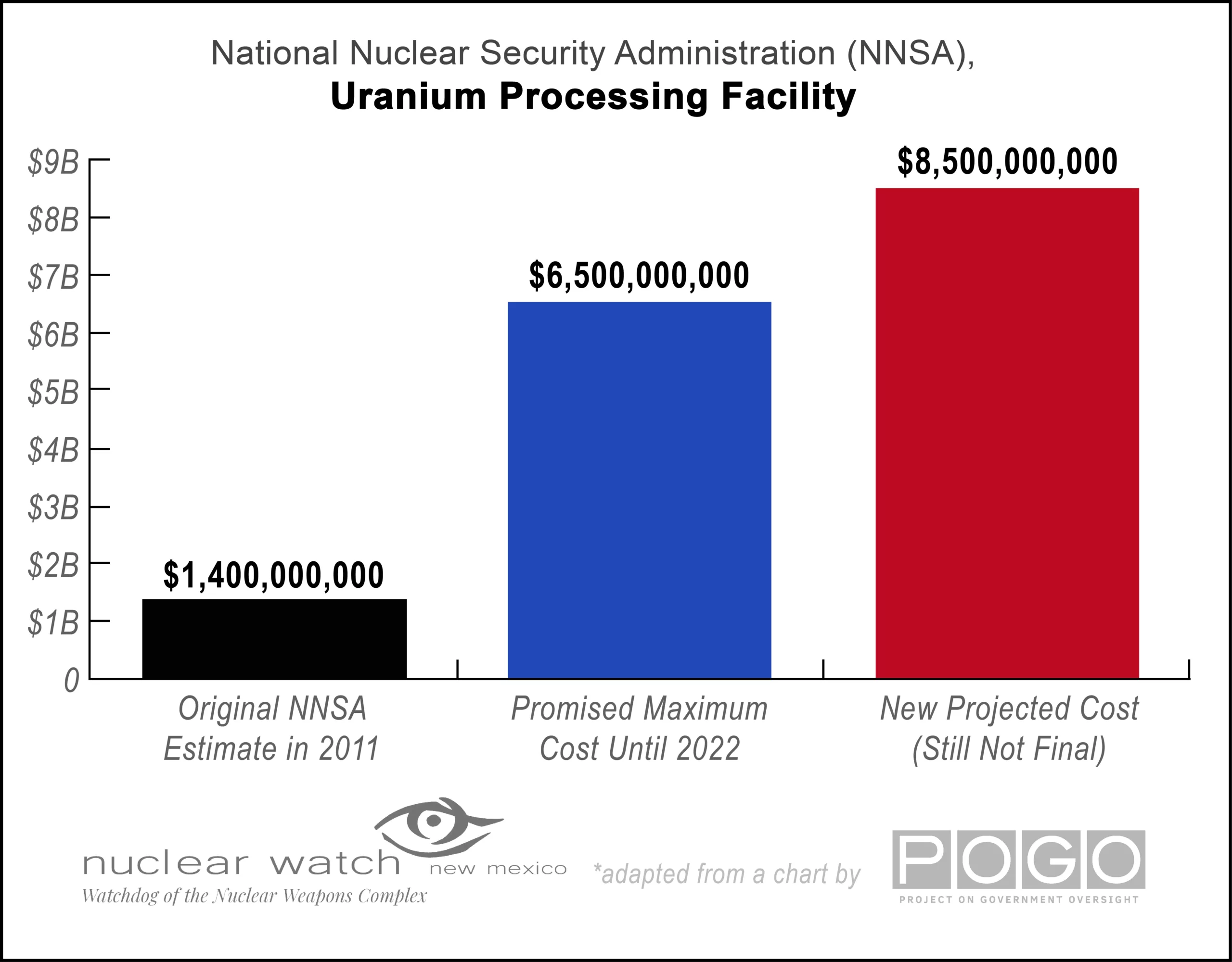 A current example is the Uranium Processing Facility (UPF) at the Y-12 Plant near Oak Ridge, Tennessee, originally estimated in 2011 to cost $1.4 to $3.5 billion. After costs started going through the roof, NNSA and Senator Lamar Alexander (R.-TN), then-chair of Senate Energy and Water Appropriations, swore that UPF would never go over $6.5 billion. But even after eliminating non-nuclear weapons production missions and a formal decision to continue operations at two old, unsafe buildings slated for replacement, the Uranium Processing Facility is now estimated to cost $8.5 billion. However, even that is not the final price, as NNSA is still to “rebaseline” UPF costs at some unspecified date.
PLUTONIUM PIT PRODUCTION BRIEFING
Jay Coghlan, Nuclear Watch New Mexico January 17, 2023 | Email
GAO report: NNSA Does Not Have a Comprehensive Schedule or Cost Estimate for Pit Production Capability, January 12, 2023, gao.gov/products/gao-23-104661
- “NNSA’s Plutonium Pit Production Scope of Work Includes Dozens of Programs, Projects, and Other Activities Managed by Multiple NNSA Offices at Multiple Sites.” p. 19
- “NNSA Does Not Have a Comprehensive Schedule or Cost Estimate for Establishing its Pit Production Capability.” p. 40
- They [NNSA officials] said they did not want to introduce uncertainty about dates and wanted to avoid releasing preliminary or unpalatable information that was subject to change.” pp. 40-41
- “NNSA will have spent billions of dollars without having an overall idea of total program costs, or when program objectives, to include the capability to produce 80 pits per year, will be reached.” pp. 55-56

The Need for Independent Pit Aging Studies
June 16, 2022 | FACT SHEETS
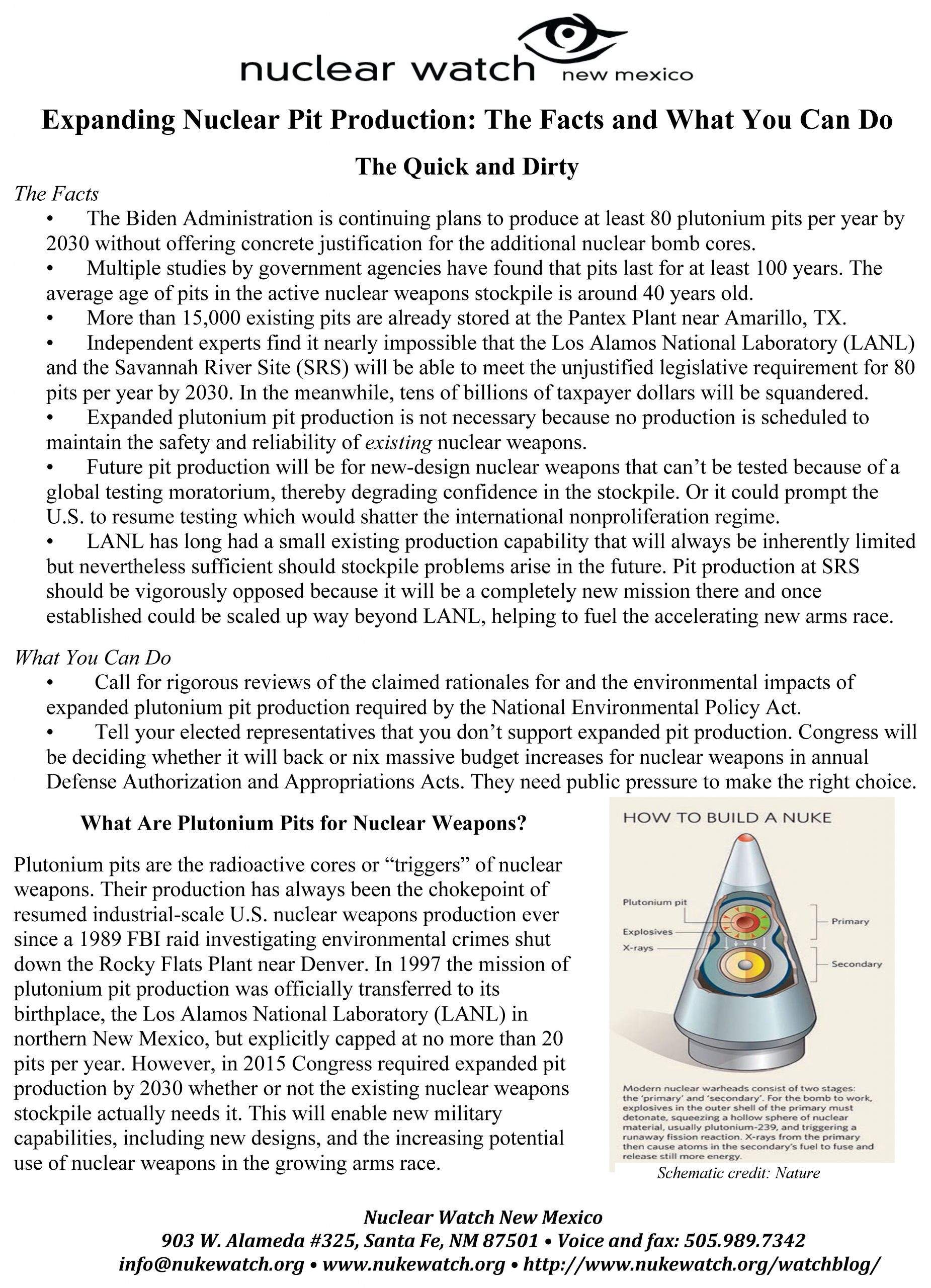
Summary: The United States is aggressively expanding the production of plutonium “pit” bomb cores to at least 80 pits per year, which the Pentagon has called the number one issue in its $1.7 trillion plan to “modernize” nuclear forces. The average age of plutonium pits is around 40 years. Los Alamos Lab Director Thom Mason has said that “The best way to deal with this dilemma [of uncertainty about aging effects] is to take it off the table. We do that by making new pits, immediately.” Thus, he justifies spending tens of billions of dollars, creating additional occupational and public risks, generating more radioactive wastes with uncertain disposal pathways, fundamentally transforming the Lab into a nuclear weapons production site and fueling the increasingly dangerous new nuclear arms race.
But does independent review of pit aging data support this need to immediately produce new pits? The answer is no given that independent experts concluded in 2006 that pits last at least a century with no determined end date. Further, no future pit production is scheduled to maintain the safety and reliability of the existing nuclear weapons stockpile – it is all for speculative new designs which could raise reliability issues or even prompt the U.S. to resume testing.
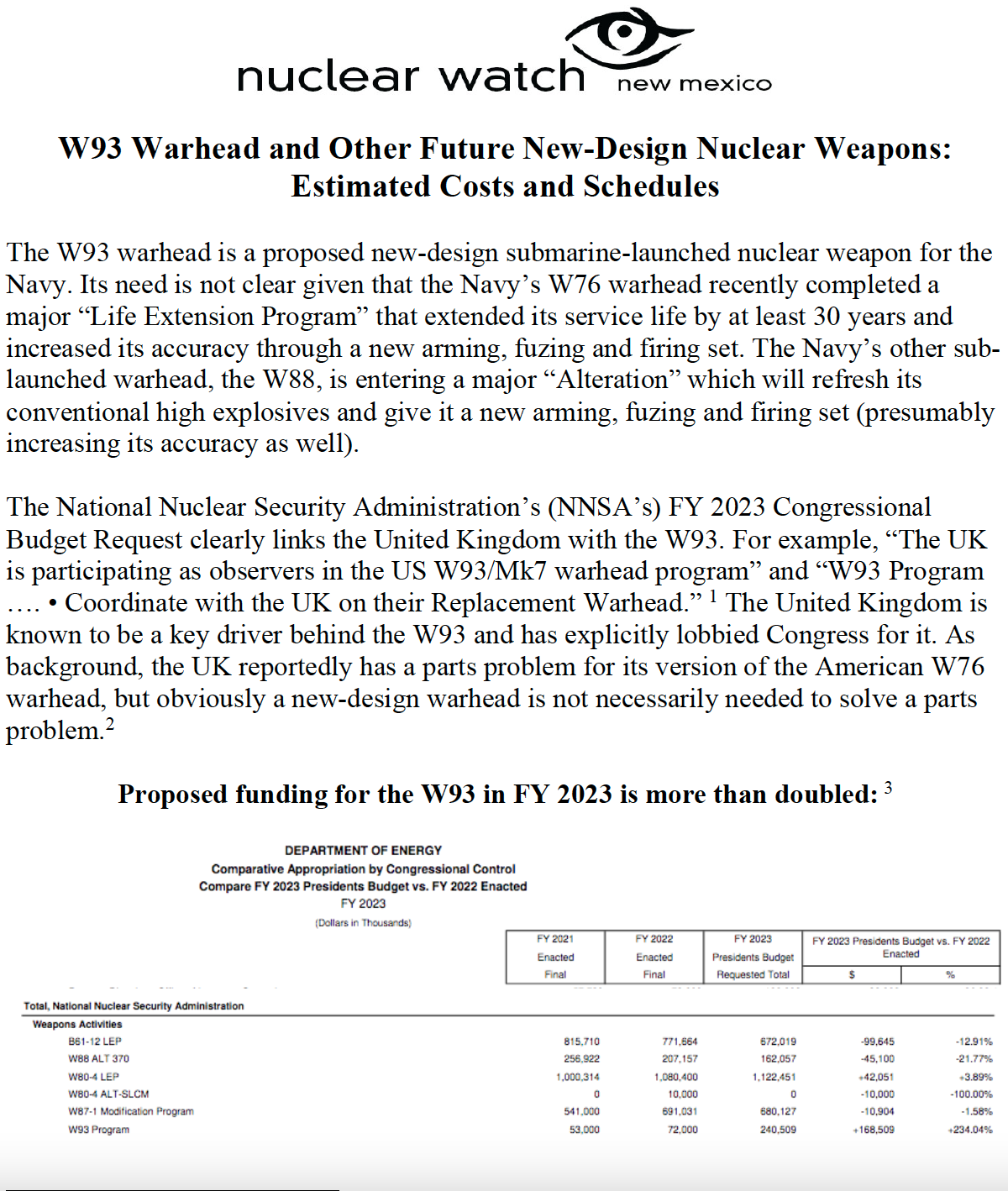

Groups Fire Back at Feds’ Move to Dismiss Plutonium Pit Lawsuit
Federal agencies continue to reject a full review of the public safety and environmental risks of producing nuclear bomb cores at multiple DOE sites.
Jay Coghlan, director of Nuclear Watch New Mexico, commented, “The government has yet to explain to American taxpayers why it will spend more than $50 billion to build new plutonium pit bomb cores for new-design nuclear weapons when we already have thousands of existing pits proven to be reliable for a century or more. This has nothing to do with maintaining the safety and reliability of the existing stockpile and everything to do with building up a new nuclear arms race that will threaten the entire world.”
/ EIN PRESSWIRE October 26, 2021
AIKEN, SOUTH CAROLINA — Public interest groups shot back at the U.S. Department of Energy and the National Nuclear Security Administration’s attempt to suppress a lawsuit seeking a comprehensive environmental review of the agencies’ plans to produce large quantities of nuclear bomb cores, or plutonium pits, at DOE sites in New Mexico and South Carolina.